
Main Menu
MyProfile
Before discussing examples of financial literacy, do you already know what financial literacy actually means?
Financial literacy refers to a person’s ability, knowledge, and understanding of how to manage finances effectively in everyday life.
By having strong financial literacy skills, you can make wiser financial decisions and manage your money more efficiently, including personal budgeting, saving, investing, debt management, and long-term financial planning.
To help you better understand the concept, here are several examples of financial literacy in daily life that you should know, along with their benefits for your financial future.



It is important for a person’s quality of life, as there are several factors that affect one’s physical fitness, such as age, gender, nutritional intake, and many more.
To help all of you to better understand this topic, in this article, we will take a closer look at the various factors that influence a person’s physical fitness. Keep reading to learn more!
When driving on the road, traffic signs play a crucial role in keeping drivers and pedestrians safe and orderly.
These signs use various symbols, letters, and numbers to provide warnings, prohibitions, instructions, or directions that are easy to recognize for all road users.
In Indonesia, traffic signs are regulated under Minister of Transportation Regulation No. 13 of 2014, ensuring that all parties properly apply their functions.
To help you understand better, here are 7 traffic signs and their meanings that every driver should know!

The stop sign is one of the most common traffic signs, typically displayed with a red background and the word "STOP" at the top.
This sign indicates that drivers must come to a complete stop and are not allowed to proceed until the road is safe. The purpose is to prevent potential traffic conflicts or accidents.

A red circle with a horizontal white stripe symbolizes the No Entry sign. It indicates that vehicles or pedestrians are not allowed to enter a particular area.
However, certain exceptions may apply to authorized parties as specified by local regulations.
A white background with the letter "S" crossed by a red line is used to indicate that stopping is not allowed.
If you see this sign, it means you cannot stop your vehicle at all, even for a short moment. Violating this rule may result in a traffic ticket based on Indonesia’s traffic law.
The No Parking sign is displayed as a large letter “P” with a red slash across it.
When this sign is placed on the road, it means vehicles cannot be parked or stopped in that area.
This sign typically has a white background with a red border and a picture of a vehicle crossed out.
If the symbol depicts a car, motorcycle, or truck, it indicates that vehicles of that specific type are not permitted to pass through the road.
For example, heavy trucks are often prohibited from entering residential areas.
The yellow triangle sign with a curved arrow warns drivers of a sharp turn, either to the left or right.
It serves as a reminder to slow down and drive carefully to avoid accidents. The signs are commonly found in hilly areas, mountain roads, or near residential zones.
A blue rectangular sign with a bridge symbol indicates that there is a bridge ahead.
Drivers are advised to reduce their speed and stay alert, as not all bridges are large or in perfect condition. Some may even have specific load restrictions that vehicles must follow.
The yellow triangular sign with a steep slope symbol warns drivers that a steep downhill road is coming.
Drivers should slow down and shift to a lower gear. This sign is usually found in mountainous or hilly regions. Before passing a steep descent, it’s essential to check your brakes to avoid brake failure.
*PT Lippo General Insurance Tbk is licensed and supervised by Financial Services Authority (OJK)
As one of the essential components in a car, the battery functions to store electrical energy needed to start the vehicle.
Due to its easy maintenance, many people today prefer using dry batteries compared to wet batteries. Moreover, there are several advantages of using a rechargeable dry battery, such as:
Longer durability compared to conventional batteries, thanks to the technology inside that ensures good electrical performance over a long period.
Easy to maintain compared to conventional batteries, which usually require regular electrolyte refills.
Easy and faster recharging capability.
Environmentally friendly as it can be recharged, reducing the number of discarded batteries and providing efficiency in resource management.
Optimal performance in various conditions, whether in extreme temperatures or for vehicles that are rarely used.
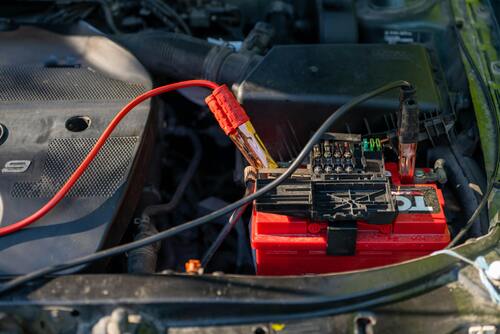
Since it can be recharged, the use of a dry battery also becomes a practical solution for users. However, doing so requires the correct steps and extra caution. So, how do you recharge a dry battery? Check out the following guide!
To ensure proper charging, the first step is to remove the dry battery from the vehicle to avoid potential risks or issues with the car.
To prevent overcharging, it is crucial to choose the type of charger that matches the specifications of the dry battery.
The next step is connecting the dry battery to the charger. Make sure the polarity is correct, then connect the charger’s positive clamp to the positive terminal and the negative clamp to the negative terminal.
With today’s modern technology, charging a dry battery is easier, as most chargers can automatically adjust the settings and the amount of charge needed by the battery.
Ensuring the right location when charging is also crucial. Typically, a well-ventilated area is the best choice.
Also, avoid charging near flames or flammable materials since batteries can produce hydrogen gas, which is highly flammable.
It is important to disconnect the dry battery immediately once charging is finished. Additionally, make sure to follow the charger’s instructions carefully throughout the process.
After charging is complete, the final step is to test the battery to ensure that the electrical capacity and voltage have returned to normal.
So, that’s the discussion regarding whether a dry battery can be recharged, the benefits of using it in vehicles, and the proper steps for recharging it. Hopefully, this guide is helpful!
*PT Lippo General Insurance Tbk is licensed and supervised by Financial Services Authority (OJK)


