Main Menu
MyProfile
In every innovation, the first step is always the most important. It lays the foundation for future developments. The same goes for the automotive world, especially cars.
Although they were not as advanced as modern vehicles, these early car models marked the beginning of a crucial era in the evolution of the automotive industry.
_Mei-02%20(1).jpg)
Starting before the 1900s, here are seven of the oldest cars in the world that came from various manufacturers and pioneered innovation in the automotive field. Let’s take a closer look!
The world’s oldest car was the Benz Patent-Motorwagen, built by Karl Benz in 1885 and patented in January 1886.
However, the name Mercedes was not used until 1901. This early car had three wheels and used a single-cylinder 954 cc engine capable of producing 0.75 bhp.
Initially, Karl Benz’s invention failed during its first public test, but he continued to refine it.
Due to his persistence, Karl Benz kept innovating, and until today, Mercedes-Benz stands as one of the most popular and respected car brands in the world.
Peugeot, founded in 1842, was originally known as a manufacturer of salt and pepper grinders.
It wasn’t until 1890 that the company produced its first four-wheeled car, the Quadricycle Type 2, equipped with a V-twin engine mounted at the rear.
In its first year, only five units were built, but by 1892 production increased to 29 units, and by 1900, Peugeot had produced 500 units.
In 1896, Henry Ford built his first experimental vehicle, the Ford Quadricycle.
After multiple tests, Ford established the Detroit Automobile Company in 1899, which later became the Henry Ford Company in 1901.
Due to disagreements with investors, Ford left the company and went on to found Ford Motor Company in 1903, which would go on to revolutionize car manufacturing worldwide.

Another early car came from Société Renault Frères, founded by Louis, Marcel, and Ferdinand Renault in 1899. They built their first-ever prototype, the 1CV Voiturette.
This vehicle could reach speeds of 32 km/h, and by 1903, the Type A model was introduced, powered by a 5 hp engine.
Fiat, short for Fabbrica Italiana di Automobili Torino, was established in 1899, and by 1900, Fiat opened its first factory, producing 24 cars in its first year.
The first Fiat car used a twin-flat 679 cc engine producing 4 hp. Later models were improved with 837 cc engines.
Thanks to these innovations, Fiat rapidly expanded from 35 employees to 2.700 employees by 1908, producing around 5.000 cars annually.
In 1862, Adam Opel founded a sewing manufacturing company, which diversified into bicycle production in 1886.
After he died in 1895, the business was continued by his wife and five sons, who introduced their first car in 1899.
The vehicle was equipped with a 1545 cc engine capable of producing 3.5 hp, and buyers could choose between two-seater or four-seater variants.
Buick is one of the oldest car manufacturers in the world, still operating today. The company first produced its prototype in 1899, under the name Buick Auto-Vim and Power Company.
Its first mass-produced model appeared in 1904, known as the Buick Model B, powered by a twin-flat 2605 cc engine that produced 16 hp.
*PT Lippo General Insurance Tbk is licensed and supervised by Financial Services Authority (OJK)
Did you know the functions of a car oil filter and its importance in maintaining engine performance? As the name suggests, this component serves to filter dirt and metal particles from the oil, ensuring the lubricant remains clean.
Because of its crucial role, regularly replacing your car’s oil filter is essential to maintain the quality of engine lubrication and prevent more serious damage to various car components.
To keep its quality intact, it’s recommended to replace the oil filter every 10.000 km or according to your car’s scheduled maintenance, especially if the vehicle is used frequently.

To help you better understand the importance of a car oil filter, here are several key functions you should know!
The main and most important function of a car oil filter is to filter out dirt that enters the engine oil.
Since the engine operates continuously, there’s a chance the oil becomes contaminated with dirt, which reduces its quality.
To keep the engine running smoothly, the oil filter acts as a sieve that keeps the oil clean from contaminants such as carbon, metal particles, and other debris, preventing them from entering the car engine.
Next, the oil filter also helps maintain engine components.
If the oil filter is damaged or missing, the filtering process cannot work properly, allowing dirt to easily enter the engine.
When this happens, the engine can become damaged more easily, and the vehicle’s performance will be disrupted. Therefore, it’s important to ensure your oil filter remains in good condition by performing regular checks.
For the car to perform optimally, the distribution of engine oil must remain stable.
One factor that can affect this is a faulty oil filter. If the component is damaged, several issues may arise, such as increased friction that can cause the engine to wear out more quickly.
If this continues, the engine’s performance may deteriorate, and its internal components could sustain significant damage.

After understanding the functions and importance of regularly replacing your car’s oil filter, you should also recognize the signs that indicate it’s time to replace it, including:
1. Decreased oil pressure, which may indicate a problem with the engine. If you experience this issue, it could be caused by a leaking or clogged oil filter that prevents oil from circulating properly.
2. Overheating engine, which occurs when a faulty oil filter restricts the oil supply, leading to increased friction and engine overheating.
3. Reduced engine performance, caused by dirt buildup or other contaminants due to a damaged oil filter, resulting in poor power output.
4. Metal grinding sounds, which may occur when a damaged oil filter restricts oil flow to the engine, causing metal components to grind against each other and reduce comfort while driving.
5. Dirty exhaust smoke, which can be a sign of a failing oil filter, often accompanied by the smell of burning oil.
*PT Lippo General Insurance Tbk is licensed and supervised by Financial Services Authority (OJK)
One of the must-have tools for mechanics, automotive enthusiasts, or vehicle owners is the socket wrench, which makes it easier to install or remove bolts.
A socket wrench is commonly used in the shock absorber area. It comes in the form of a tube, with a hollow hexagonal shape on one end and a twelve-point opening on the other.
To better understand the functions of a socket wrench, especially for vehicles, check out the explanation below!
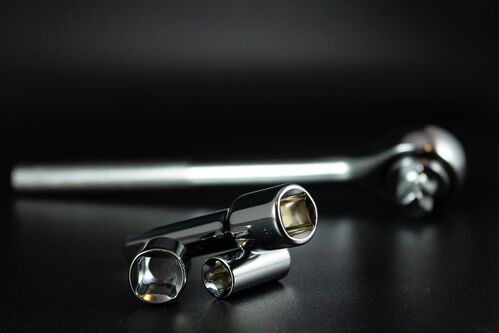
The primary function of a socket wrench is to remove and install nuts and bolts in various parts of the vehicle.
From wheels, brakes, and shock absorbers to other engine components that are located deep inside and hard to reach, a socket wrench makes the job much easier.
Another function for socket wrenches is to loosen and tighten bolts and nuts. A socket wrench can be used to adjust the desired level of tightness based on the needs of the repair or installation.
A socket wrench is also frequently used for repairing suspension components such as shock absorbers, springs, and coils.
Because of its shape, a socket wrench can be used to access tight spaces, making it easier to turn nuts or bolts.
In addition, in areas that are hard to reach, adding an extension bar or handle to the socket wrench helps in removing, installing, loosening, or tightening bolts and nuts with greater convenience.
Available in various sizes and designs, a socket wrench offers flexibility for mechanics or vehicle owners to adjust according to the nuts and bolts being worked on, making the process more efficient.
Based on the size of the drive hole, socket wrenches are available in four types:
1/4 inch or 0.6 cm socket wrench
3/8 inch or 0.9 cm socket wrench
1/2 inch or 1.3 cm socket wrench
3/4 inch or 1/9 cm socket wrench
Next, based on the tube length, socket wrenches are divided into two types:
Standard or short socket wrench, generally used for tightening or loosening nuts and bolts with high torque.
Deep or long socket wrench, used for tightening or loosening nuts and bolts with medium torque.
Finally, socket wrenches can also be distinguished by the number of points in the socket:
6-point socket, commonly used for high torque tightening.
12-point socket wrench, designed for smaller turning angles.
8-point socket wrench, often used for specific tightening needs.
So, that’s the discussion about socket wrenches you need to know. From their functions to the different types available.
Thanks to their usefulness, socket wrenches are one of the essential tools that vehicle owners should have, especially for emergencies such as flat tires, loose car components, or other technical issues on the road.
With this tool, drivers can handle urgent problems first before taking their car to the nearest workshop or mechanic. Hopefully, this information is useful!
*PT Lippo General Insurance Tbk is licensed and supervised by Financial Services Authority (OJK)
Paying taxes on time is very important, neglecting to do so can result in accumulating fines.
The same applies to vehicle taxes, such as the car tax. If not paid promptly, the penalty can impact your financial condition. So, how exactly do you calculate it, and what is the fine for late car tax payment?
Before knowing how to calculate it, there are 2 important things you need to understand regarding car tax penalty calculation, such as:

The fine that must be paid is calculated based on the length of time the tax has been overdue, consisting of 2 components:
PKB Fine or Motor Vehicle Tax, 25% per year of the PKB amount, calculated proportionally per month (25% x months /12).
SWDKLLJ Fine, fixed additional charge according to regulations, generally Rp 100.000 for cars, depending on vehicle type.
1 day late, no fine.
1 week to 1 month late, PKB fine 4.17% + SWDKLLJ.
2 months late, PKB fine 4.17% + SWDKLLJ.
3 months late, PKB fine 6.25% + SWDKLLJ.
4 months late, PKB fine 8.33% + SWDKLLJ.
5 months late, PKB fine 10.42% + SWDKLLJ.
6 months late, PKB fine 12.5% + SWDKLLJ.
7 months late, PKB fine 14.58% + SWDKLLJ.
8 months late, PKB fine 16.67% + SWDKLLJ.
9 months late, PKB fine 18.75% + SWDKLLJ.
10 months late, PKB fine 20.83% + SWDKLLJ.
11 months late, PKB fine 22.92% + SWDKLLJ.
1 year late, PKB fine 25% + SWDKLLJ.
2 years late, PKB fine 50% + SWDKLLJ.
3 years late, PKB fine 75% + SWDKLLJ.
To better understand the calculation, here is an example of a car tax fine calculation if the payment is late for 6 months, with Motor Vehicle Tax or PKB of Rp 364.200 and SWDKLLJ of Rp 243.000:
The formula is, PKB x 25% x 6/12
Rp 364.200 + Rp 243.000 x 25% x 6/12 = Rp 394.575
However, please note that the total amount to be paid is not just Rp 394.575. There are additional charges for PKB and SWDKLLJ, making the total Rp 364.200 + Rp 243.000 + Rp 394.575 = Rp 1.001.775, which is the total that must be paid.
The longer the time taken to settle the payment obligation, the higher the fine to be paid.
To ensure the amount of fine that must be paid and to get a more accurate PKB fine amount, you can check it through the official e-Samsat website using the following steps:
Open the website e-Samsat.id
Go to the vehicle tax check menu
Enter the vehicle number and date of birth
Click check
View the result of the car tax fine check that must be paid. This page also includes information on PKB POK, PKB DEN, SWDKLLJ POK, SWDKLLJ DEN, PNPB STNK, PNPB TNBK, and the tax payment due date.
So, that’s the discussion about how much the fine for late car tax payment is, which you need to know so you can immediately pay your vehicle owner’s obligation. Hopefully, this information is useful!
*PT Lippo General Insurance Tbk is licensed and supervised by Financial Services Authority (OJK)